.svg)
Plan your POP UP
MENU
Costs, locations, formats, and what to look for in an agency.
A pop-up shop is a part of a marketing plan that has to work in front of a paying customer on a fixed date. The campaign can be polished, the renderings beautiful, the run-of-show airtight, and none of that matters if the line moves slowly, the staff can't answer product questions, or the POS goes down at 2 p.m. on the busiest day.
A strong pop-up shop needs more than a good idea. The concept, the location, the operations, and the customer experience all need to hold together once the doors open. The questions below are the ones brands ask before they hire one.
"Pop-up shop" is a catch-all. Brands and agencies use it interchangeably with pop-up store, pop-up storefront, pop-up boutique, pop-up retail, pop-up truck, and pop-up event. They all describe the same thing: a temporary physical space where a brand sells, samples, or hosts customers for a defined window, anywhere from one day to several months.
Format is where the differences are real. The most common shapes a pop-up shop takes:
The right format is a function of the goal, the budget, the city, and the time the team has to build it.
Sales matter, but they are rarely the only reason. Most pop-up shops are designed to deliver four returns at once:
Brands that treat the pop-up as only a sales engine almost always underperform the brands that design for all four.
A pop-up shop costs anywhere from the low five figures to the low seven figures. Where a project lands inside that range is almost entirely a function of build complexity, location, and duration.
Four levers move the number more than anything else:
A pop-up in the wrong location is a build without an audience. Strong locations fall into four categories, each with a different trade-off.
Street-level retail in fashion and culture districts. SoHo in New York, Abbot Kinney in Los Angeles, Shoreditch in London, Le Marais in Paris. These give a brand walk-by traffic and a credible address. They book out fast for fashion week, holiday, and major launch windows, and rent during those windows reflects it.
Outdoor lifestyle centers and high-traffic shopping plazas. The Grove in Los Angeles, Rockefeller Center in New York, and Westfield London. These put a brand in front of a shopper who is already out to spend. They come with stricter design and operational requirements, which is partly why they convert.
Cultural venues and event-adjacent spaces. Galleries, hotels, festival grounds, college campuses. These work when the goal is content, community, or alignment with a cultural moment. Permitting is more bespoke, but the environment is too.
Mobile formats. Custom trucks, pop-up trailers, branded carts. These work when the goal is multiple cities or neighborhoods in a single tour. Cost per opening day is higher, but the build amortizes across many activations.
A capable agency owns sourcing, negotiation, and permitting from the start. This is where most do-it-yourself pop-up plans lose 2 to 4 weeks of time.
The agency market is crowded, and the labels are slippery. Some "experiential agencies" do strategy and concept, then hand the build to a production vendor. Some "production companies" can build anything, but can't help with the brand story. The right partner depends on how much you want to hand off and how much you plan to run yourself.
For brands looking for a single agency to carry a pop-up shop from concept to a working storefront, four criteria filter out most of the noise.
Operational depth. Anyone can render a beautiful space. The harder question is whether the agency can run the storefront day after day. Ask how they handle staffing, training, POS setup, real-time inventory, security, and end-of-day reporting. Operations is where most pop-ups fail. The agencies that win on pop-ups treat it as a core capability, not an afterthought handed to a temp staffing firm.
Design fidelity. Renderings are a contract. The agency's renderings should match what gets built, down to the materials, the colorways, and the lighting. Ask to see a render-versus-reality comparison from a recent project. Hesitation here means the renderings are decoration, not a build document.
Vertical integration. Fewer hand-offs means fewer things break. Agencies that run their own design, production, and operations under one roof move faster and lose less in translation. Multi-vendor stitching adds weeks and risk.
Category track record. Beauty, fashion, food and beverage, and tech all run on different operational rhythms. An agency that has produced pop-ups in your category will already know the permitting quirks, staffing models, merchandising standards, and cultural calendar that matter for your launch.
The agencies that score well on all four are the ones brands keep returning to.
A capable agency takes ownership of the brief through the final day on the floor. The work moves through four phases that overlap more than a Gantt chart suggests.
Strategy and creative. Strategy and creative leads work with the brand to define the goal, the audience, the format, and the story the space needs to tell. The output is a creative direction the brand can sign off on before any money goes into production.
Design and rendering. Designers translate the concept into floor plans, elevations, and high-fidelity 3D renderings, walk-through angle by walk-through angle. This is the render to reality stage. What gets approved here is what gets built.
Production and location. Fabrication, location sourcing, permitting, vendor coordination, and tech integration run in parallel. The agency lines up the storefront, the build crew, the POS hardware, the inventory flow, and the staff. The brand's job is to approve, not to manage.
Operations. Once the doors open, the floor needs staff management, customer flow, inventory tracking, POS support, security, daily reporting, and end-of-day reconciliation. For a multi-week storefront, this is the largest single share of the agency's hours and the most common place where unprepared partners come apart.
Pop Up Mob runs all four as a one-stop shop with an à la carte menu. A brand can hand off the full project, from concept to execution and every gradient in between, or bring the agency in for a specific phase. Most engage end-to-end. Some hand off only the build and operations, and keep creative in-house.
Three recent Pop Up Mob projects, at three different scales, in three different cities:
YSL Beauty Lash Latex Studio at The Grove, Los Angeles. A one-day, 20-by-10-foot pop-up shop positioned directly in front of the Sephora at The Grove. The build translated YSL's Lash Latex campaign into a physical environment, featuring a gym-themed structure with rubber flooring, mirrored acrylic walls, brushed aluminum signage, and a high-gloss ceiling. Visitors moved through stretching, raising, and sculpting moments anchored by a custom latex-wrapped logo and a 3D Cassandre photo prop. The single 12-hour day drew 1,571 visitors, distributed 500 chocolate protein balls and 800 charcoal lemonades, and routed traffic into the adjacent Sephora with a bounce-back gift-with-purchase card.
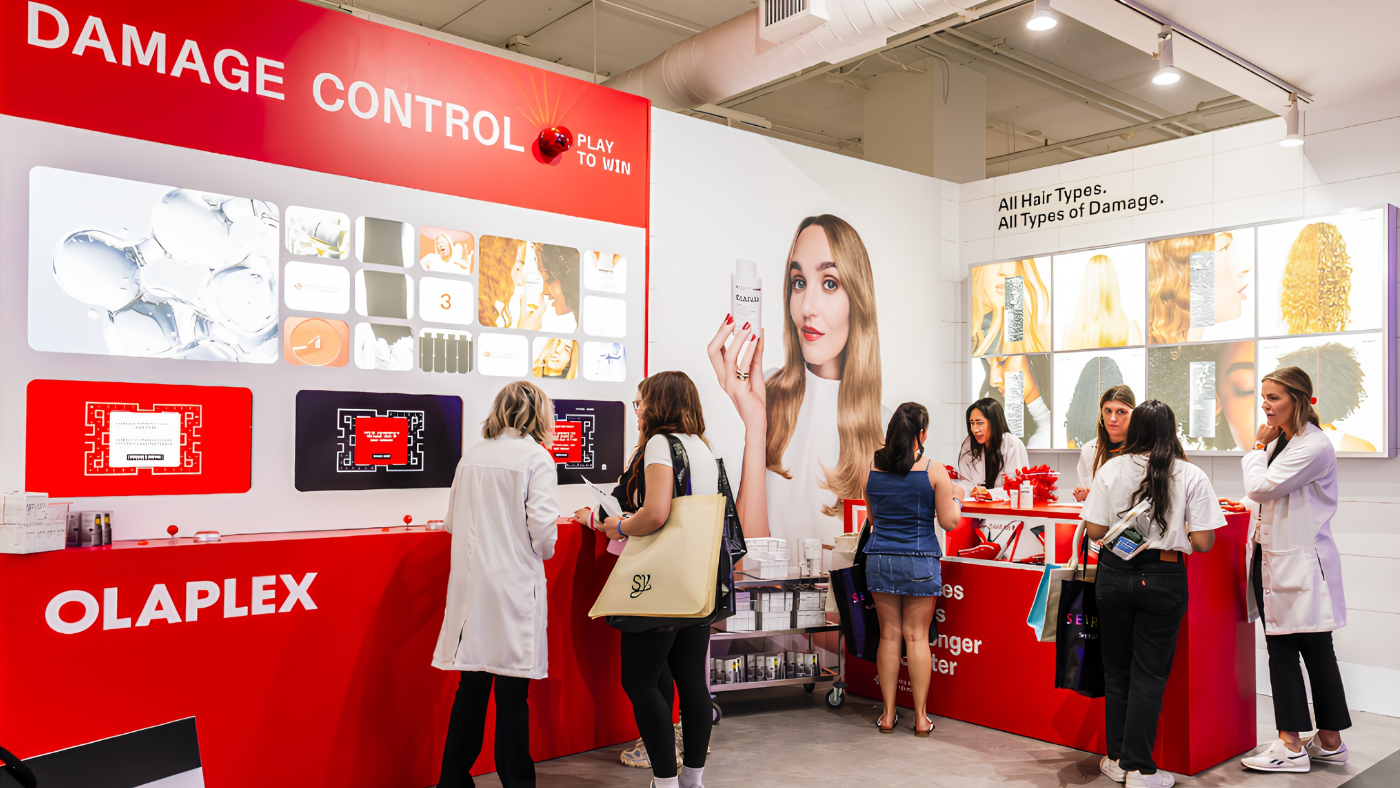
Olaplex Lab in SoHo, New York. A six-day pop-up shop for the launch of Olaplex N.3 Plus, transforming a SoHo storefront at 45 Grand Street into an immersive lab environment. The space featured red tile walls, oversized product replicas as architectural anchors, FitSkin hair scanning stations, a touch-and-feel hair wall treated with the new product, magnified viewing lenses, and an interactive Pacman-style educational game. The run opened with a press and influencer night that hosted 288 industry guests, then opened to consumers for two days that drew 881 and 1,251 visitors respectively, with traffic increasing 42% day over day. Total attendance crossed 2,400.
ASOS Holiday Pop-Up Storefront in New York City. A roughly two-week holiday pop-up storefront for ASOS in New York, with a parallel installation in London. The build leaned into a winter wonderland concept, drawing on the visual qualities of ice through plexi and metal as primary materials. Beyond the design, the storefront ran as a working retail space, with managed staffing, POS systems, real-time inventory, and a guided shopping path that held up through peak holiday foot traffic. The format is built to be repeatable across markets and is now part of an ongoing rotation of ASOS storefronts in the United States and the United Kingdom.
Pop Up Mob is a women-owned global agency that has produced more than 250 pop-up activations for more than 175 brands across 15 industries since 2014. Teams sit in New York, Los Angeles, Austin, Miami, Madrid, London, and Dubai, with projects shipped in more than 10 countries.
Recent pop-up shop work spans:
Industry recognition includes Adweek's Fastest Growing Agencies (2020), Event Marketer's Top 100 It List (2023), and BizBash's Top 50 Event Designers (co-founder Ana Pelucarte, 2019). The team that designs the renderings is the team on the floor running the store on opening day.
The pop-up shops that hit their goals come down to two variables: an idea worth building and a partner who can carry it from a brief into a working storefront. The idea matters. The location matters. The execution matters, but the partner is the variable that decides whether everything else lands.
The agencies that consistently produce strong pop-up shops share four traits: operational depth, design fidelity, vertical integration, and a category track record. Those traits are what allow renderings to become buildings, plans to become open doors, and a marketing budget to come back as foot traffic, sales, and content.
Pop Up Mob has produced more than 250 pop-up shops since 2014 by holding all four traits under one roof. The pop-up calculator is the fastest way to put a number against an idea, and the featured projects show what the work looks like across categories and scales.
How much does a pop up shop cost?
Low five figures for a one-day guerrilla format, mid to high six figures for a typical retail-scope run, and high six to low seven figures for a flagship multi-week build. Location, build complexity, duration, and staffing model are the four levers that move the number the most. The Pop Up Mob calculator puts a real number against an idea in about five minutes.
How long does a pop up shop usually run?
One day to several months. One-day formats work for guerrilla activations, product trial moments, and single cultural events. Two-to-four-week runs are the most common length for retail-focused pop ups because they give a brand enough time to build word of mouth without locking into a long-term lease. Multi-month runs work for shop-in-shops and seasonal storefronts.
How long before opening do I need to hire a pop up shop agency?
Three to six months for a custom build. That window covers concept, design, location sourcing, permitting, fabrication, staff training and inventory prep. Faster timelines work for simpler formats or when the brand already has a creative direction in hand, but the shorter the runway, the more the location and design options narrow.
What is the difference between a pop up shop and a pop up store?
There isn't one. Both terms describe a temporary, branded retail space open for a defined window. "Pop up store" is more common when the format is closer to a working retail door. "Pop up shop" is more common in beauty, fashion and lifestyle. Both can sell, sample, host or all three.
Can a smaller or emerging brand afford a pop up shop?
Yes. A first pop up shop for an emerging brand often runs as a one-day or weekend format inside a partner space, a shared retail location or a guerrilla footprint. Pop Up Mob works with both global enterprise clients and emerging brands and scales the team and the build to the budget.
Where can I find pop-up shop locations?
Street-level retail in fashion districts, lifestyle centers, hotels, galleries, festival grounds, and college campuses are all standard. Sourcing, negotiating,g and permitting the space is one of the things a capable agency takes off the brand's plate. A brand should not need to find the storefront themselves.
What kind of staff does a pop-up shop need?
A standard pop-up runs on a brand ambassador team, a sales lead, a POS operator, a stock and inventory lead, and a security presence sized to the location. Premium activations and VIP days add a stylist, a host, or a brand educator. The agency typically sources and trains the team and runs daily briefings on-site.
Do pop-up shops actually generate sales?
Yes, when they are designed for it. A working POS, a curated assortment, and a staff trained to convert are the differences between a pop-up that sells and a pop-up that only impresses. The strongest pop-up shops also keep generating returns long after they close, through earned media, organic social content,t and email capture from on-site traffic.